
Single-Tooth vs. Full-Arch Dental Implants
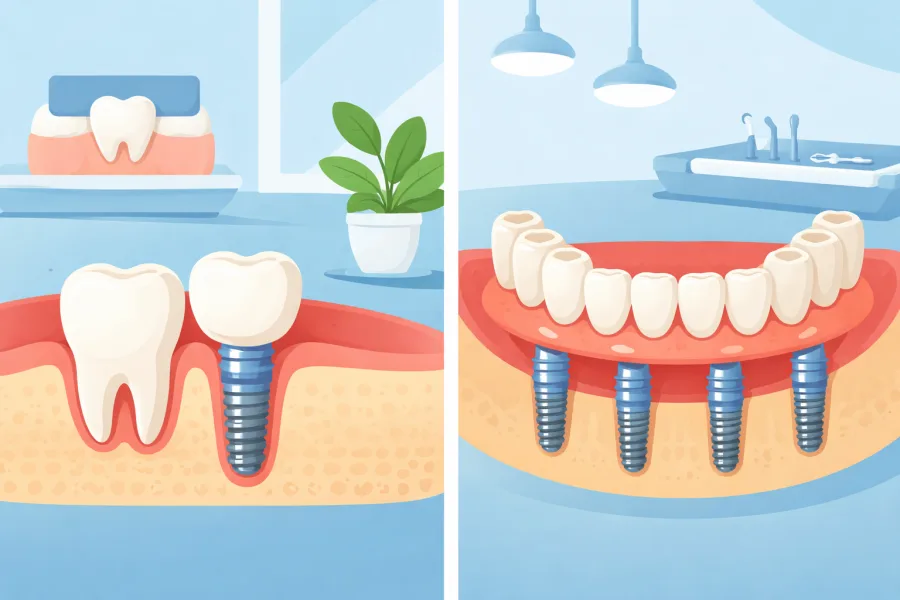
Losing teeth affects much more than your smile. It alters how you chew, how clearly you speak, and how confident you feel when socializing or sharing a meal. Fortunately, modern dental implants offer permanent, lifelike replacements that look, feel, and function just like natural teeth. When deciding on treatment, the primary choice comes down to scope: do you need an independent single-tooth implant or a comprehensive full-arch restoration?
Both treatment pathways utilize medical-grade titanium posts that fuse directly to your living jawbone through osseointegration. However, the surgical planning, procedural steps, recovery experience, and financial investment differ substantially. Here is what you should understand about each option before sitting down with your surgeon.
Single-Tooth Implants: Independent Stability for an Isolated Gap
When a single tooth is lost to dental decay, severe trauma, or failed root canal therapy, an isolated dental implant is the gold standard solution. Unlike traditional bridges that require grinding down the enamel of healthy neighboring teeth, a single implant stands completely on its own.
The oral surgeon places a titanium implant post directly into the jawbone socket. Over a three to four month healing window, bone cells knit tightly around the post, creating an artificial root. Once healed, an abutment connector and custom ceramic crown are attached. This approach offers several notable clinical benefits:
- Protection for Adjacent Teeth: Natural teeth on either side remain untouched, preserving their protective enamel and structural strength.
- Targeted Bone Preservation: Chewing forces stimulate the underlying bone, preventing the localized bone resorption that inevitably follows tooth extraction.
- Flossable and Natural: Because it emerges from the gumline like a natural tooth, you brush and floss normally without threading instruments under a bridge.
Full-Arch Implants: Total Smile Reconstruction on Four to Six Anchors
If you are missing all or most of your teeth across an entire dental arch, or if remaining teeth are severely broken down from periodontal disease, restoring teeth one by one is neither practical nor cost-effective. Full-arch rehabilitation, often called All-on-4 or full-arch fixed implant restoration, solves this challenge using strategic engineering.
Instead of placing an implant for each missing tooth, your oral surgeon places four to six implants across the dental arch. Two posterior implants are angled up to 45 degrees to maximize contact with dense frontal bone and bypass anatomical limits like the maxillary sinus or inferior alveolar nerve. A custom, rigid zirconia or hybrid bridge is then securely screwed onto these anchors:
- Fixed and Non-Removable: Your restoration stays firmly locked in your mouth. There are no loose plates, no messy adhesives, and no clicking when you speak.
- Immediate Function: In many cases, patients receive a beautiful, fixed temporary bridge on the day of surgery, meaning you never leave our office without teeth.
- Full Bite Restoration: You can comfortably enjoy steak, crisp apples, and crunchy vegetables with upwards of 80 to 90 percent of natural bite power restored.
Direct Comparison: Procedure Scope, Healing, and Investment
Selecting the right approach depends on your dental history, current bone volume, and personal lifestyle priorities:
- Surgical Time and Sedation: Single-tooth placement takes 30 to 45 minutes and is easily completed under local anesthesia or light nitrous oxide. Full-arch surgery is more comprehensive, taking two to three hours per arch, and is typically performed under comfortable IV sedation.
- Recovery Timeline: Single implant patients usually return to work the next morning with mild soreness managed by ibuprofen. Full-arch patients should plan for three to five days of restful downtime to allow soft tissue swelling to peak and resolve.
- Long-Term Economics: While full-arch surgery requires a larger upfront investment, it eliminates decades of ongoing dental repairs, recurring root canals, and repeated denture replacements, delivering extraordinary lifetime value.
Restoring Your Bite with Dr. Johanny Caceres in Coral Gables
Whether you need to replace a single missing incisor or wish to rebuild your entire smile from the ground up, success begins with precision diagnostic planning. Board-certified oral and maxillofacial surgeon Dr. Johanny Caceres utilizes 3D cone-beam CT imaging and computer-guided surgery to plan every implant position with sub-millimeter accuracy.
We take time to listen to your concerns, evaluate your bone structure, and design a customized treatment plan that fits your health and goals. To discuss your implant options, contact Oral & Facial Surgery of Miami in Coral Gables at (305) 552-1193 or schedule your surgical consultation online.