
What is Bone Grafting Surgery? Types, Recovery & FAQs
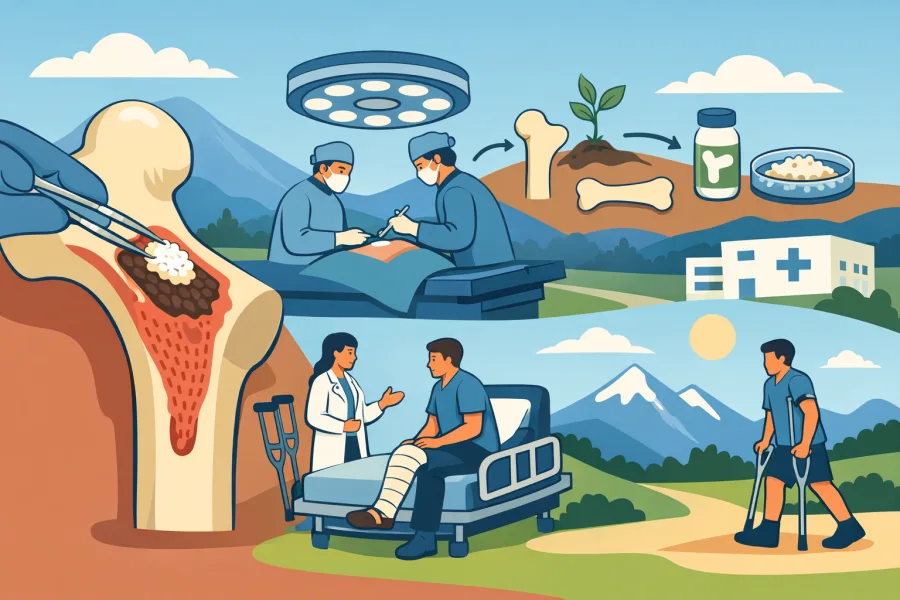
When patients hear the words "bone grafting surgery," their minds often picture an invasive hospital procedure or an orthopedic bone harvest from another part of their body. For anyone preparing for a dental implant, this misconception can cause unnecessary worry and delay needed treatment.
In modern oral and maxillofacial surgery, dental bone grafting is a routine, minimally invasive in-office procedure that takes less than an hour. Rather than cutting away living bone, the surgeon places a specialized mineral scaffold into areas of depleted jaw volume, guiding your body's natural regenerative cells to rebuild strong, living bone. Here is a clear clinical breakdown of the four main types of oral bone grafts, what the procedure feels like, and answers to the most common patient questions.
How Bone Regeneration Works in the Jaw
Your jawbone is a dynamic tissue that requires constant stimulation to remain thick and healthy. When a tooth is lost to trauma, infection, or extraction, the surrounding alveolar bone loses that mechanical stimulation and begins to resorb rapidly. Within the first year, an unmanaged socket can lose nearly half of its natural width.
Bone grafting stops and reverses this resorption through a biological process called osteoconduction. The graft material acts as a microscopic three-dimensional trellis. Over the course of three to six months, your body's osteoblasts (bone-building cells) migrate into this trellis, depositing fresh calcium and collagen while gradually dissolving the donor matrix. The result is your own living, vascularized bone, perfectly suited to anchor a dental implant.
The Four Primary Types of Oral Bone Grafting Procedures
Depending on where bone volume has been lost and what type of restoration you need, your oral surgeon will recommend one of four targeted techniques:
- Socket Preservation (Ridge Preservation): Performed immediately at the time of tooth extraction. The surgeon fills the empty root socket with bone granules and seals it with a small collagen plug, preventing the bony walls from collapsing inward as the gum heals.
- Ridge Augmentation: If a tooth has been missing for months or years, the alveolar ridge often narrows into a sharp, thin knife-edge. Ridge augmentation widens or heightens the bone ridge so an implant can be completely enclosed within solid bone.
- Sinus Lift (Subantral Augmentation): In the upper back jaw, natural bone is often naturally thin, and the maxillary sinus cavity lies just above tooth roots. A sinus lift gently elevates the sinus membrane and places bone beneath it, creating the vertical height necessary for secure molar implants.
- Periodontal Bone Grafting: Used to rebuild localized craters of bone loss around natural teeth caused by severe periodontal disease, stabilizing loose teeth and preventing premature extraction.
What the In-Office Appointment Involves
Most bone grafts are performed entirely in-office under local anesthesia, nitrous oxide (laughing gas), or light intravenous sedation for maximum relaxation:
- Site Preparation: The surgeon cleans the target area thoroughly, ensuring all debris or chronic bacteria are cleared.
- Graft Placement: Sterile mineral granules (typically a purified human allograft or bovine xenograft) are packed into the bony defect with micro-surgical precision.
- Membrane Protection: A resorbable collagen barrier membrane is placed over the graft granules. This Guided Bone Regeneration (GBR) technique prevents fast-growing soft tissue cells from migrating into the site before the slower bone cells can organize.
- Suturing: The site is secured with fine dissolvable stitches. The entire visit typically takes 30 to 45 minutes, and patients drive themselves home if local anesthesia alone was used.
Frequently Asked Clinical Questions
Does bone grafting hurt?
During the procedure, you will be completely numb and will feel only light touch and water spray, with
zero cutting pain. Post-procedure soreness is mild, comparable to having a small dental filling or mild
bruise, and is easily controlled with over-the-counter medications like ibuprofen for 48 hours.
Can my body reject the graft?
True immunological rejection does not happen with modern bone grafts. Processed allografts and
xenografts
are thoroughly stripped of all living cellular antigens and proteins, leaving only sterile mineral
minerals. The primary risk is not rejection, but localized infection or early mechanical disruption,
both
of which are preventable by following gentle aftercare instructions.
How long before my dental implant can be placed?
For small socket preservation grafts, implant placement can often occur in 3 to 4 months. For larger
ridge augmentations or sinus lifts, full bone maturation typically takes 4 to 6 months before your
surgeon
verifies solid integration with a low-dose 3D cone-beam CT scan.
Personalized Bone Grafting Care at OFS Miami
Losing bone in your jaw does not mean you have to live with missing teeth or loose dentures. At Oral & Facial Surgery of Miami, board-certified oral and maxillofacial surgeon Dr. Johanny Caceres provides gentle, precise bone grafting and implant reconstructive care in a calm, modern environment.
Whether you are planning a single tooth replacement or comprehensive full-arch restoration, our team is here to restore your oral health with confidence. Call Oral and Facial Surgery of Miami today at (305) 552-1193 or schedule a consultation online.