
How Bite Correction Surgery Fixes Overbite, Underbite, and Jaw Alignment
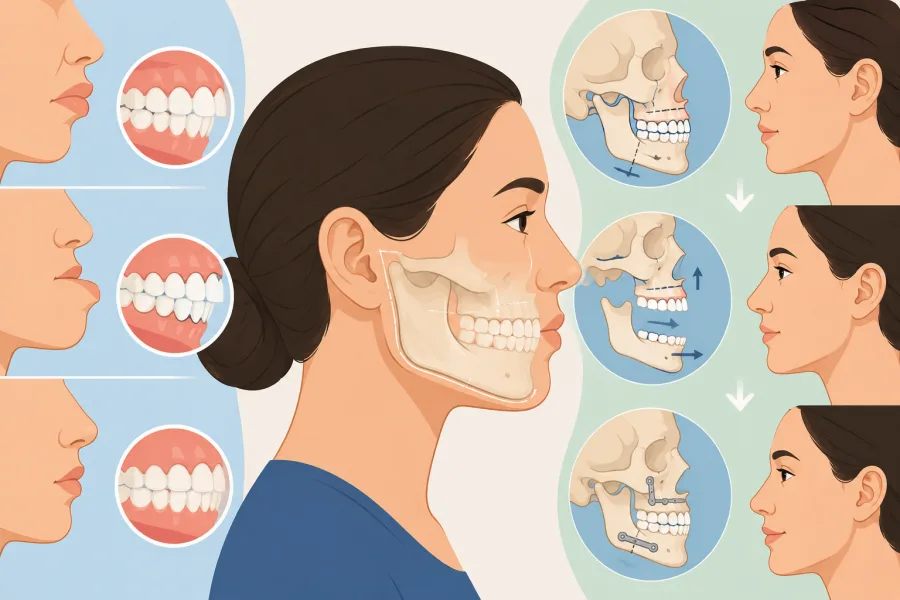
Living with a misaligned bite affects far more than just your smile. When your upper and lower jaws do not align in harmony, everyday activities like chewing a sandwich, enunciating certain syllables, or breathing effortlessly during sleep become persistent challenges. Many adults spend years wearing braces or clear aligners, only to discover that their bite problem stems from the underlying jawbones rather than crooked teeth alone.
Bite correction surgery, clinically known as orthognathic surgery, resolves fundamental skeletal discrepancies between the maxilla (upper jaw) and mandible (lower jaw). By repositioning the facial bones into functional and aesthetic balance, this surgery transforms your chewing mechanics, relieves TMJ strain, opens restricted airways, and creates natural facial symmetry.
1. Skeletal vs. Dental Discrepancy: When Orthodontics Reaches Its Limit
Orthodontic treatment moves teeth within existing alveolar bone. However, when the jawbones themselves differ significantly in size, length, or spatial angle, moving teeth alone cannot solve the problem. Attempting to force teeth into contact without correcting the bone foundation is called "orthodontic camouflage," which frequently causes gum recession, root resorption, and long-term relapse.
Orthognathic surgery is required for definitive correction of four major skeletal patterns:
| Malocclusion Pattern | Skeletal Cause | Functional & Airway Consequences |
|---|---|---|
| Severe Overbite / Retrognathia (Class II) | Underdeveloped, retruded lower jaw or protruding upper jaw. | Lower incisors bite painfully into palate roof; retracted tongue base collapses pharyngeal airway, causing obstructive sleep apnea. |
| Severe Underbite / Prognathism (Class III) | Overdeveloped lower jaw, deficient midface (hypoplastic maxilla), or both. | Inability to incise foods, chronic temporomandibular joint (TMJ) strain, premature molar wear, and distinct concave facial profile. |
| Anterior Open Bite | Back molars contact prematurely while front teeth cannot touch when closing. | Inability to bite into food with front teeth; lisping speech patterns; accelerated destructive wear on posterior molars. |
| Vertical Maxillary Excess ("Gummy Smile") | Overgrowth of the upper jaw bone in a vertical downward direction. | Inability to close lips at rest without straining chin muscles (lip incompetence), leading to chronic mouth-breathing and dry oral tissues. |
2. Surgical Modalities: LeFort I, BSSO, and Sliding Genioplasty
Orthognathic procedures are performed entirely from inside the mouth, leaving no visible scars on the facial skin. Modern techniques utilize rigid internal fixation, which means miniature titanium plates and screws stabilize the bones immediately, eliminating the historic need to wire jaws shut.
- LeFort I Maxillary Osteotomy: The oral surgeon makes an incision above the upper teeth, carefully releasing the upper jaw. The maxilla can then be repositioned forward, backward, raised (impaction) to correct a gummy smile, or widened to eliminate crossbites.
- Bilateral Sagittal Split Osteotomy (BSSO): Performed on the lower jaw behind the molars. The surgeon splits the ramus of the mandible lengthwise along the natural cortical plane, preserving the inferior alveolar nerve within the bone channel. The lower jaw is advanced forward or guided backward into exact dental alignment.
- Sliding Genioplasty: The bony chin point can be horizontally advanced, vertically shortened, or centered alongside jaw surgery. Advancing the chin muscle attachments pulls the genial tubercles forward, tightening the anterior floor of the mouth and further expanding the hypopharyngeal airway.
3. The Treatment Journey: Virtual Surgical Planning (VSP) & Orthodontics
Achieving a flawless bite requires close partnership between your orthodontist and your oral and maxillofacial surgeon:
- Phase 1: Pre-Surgical Orthodontic Decompensation (12 to 18 months): Braces or aligners align each arch independently over its own basal bone, intentionally exposing the true skeletal discrepancy so the jaws can lock into perfect harmony on surgery day.
- Phase 2: Virtual Surgical Planning (VSP) & 3D Modeling: Using high-resolution CBCT scans and optical dental scans, our team creates a 3D digital simulation of your facial skeleton. The surgical movements are planned down to fractions of a millimeter on a computer screen, and custom 3D-printed surgical splints guide your exact repositioning in the operating room.
- Phase 3: Surgery & Early Recovery (4 to 6 weeks): Performed under general anesthesia. Most patients return home within 24 hours, following a smooth liquid to soft-chew diet while bone healing takes place.
- Phase 4: Post-Surgical Detailing (3 to 6 months): Your orthodontist makes final micro-adjustments to interlock individual tooth cusps into a permanent, stable occlusion.
4. Transforming Your Bite at Oral & Facial Surgery of Miami
Bite correction surgery is one of the most rewarding procedures in modern medicine. Patients report dramatic improvements in their ability to chew nutritious foods, immediate relief from chronic jaw joint headaches, and a profound boost in self-confidence when smiling.
At our practice, board-certified oral and maxillofacial surgeon Dr. Johanny Caceres provides advanced orthognathic care utilizing state-of-the-art 3D imaging, digital airway analysis, and computer-guided surgical navigation in Coral Gables. Whether you are addressing an uncorrected childhood bite problem or seeking relief from sleep apnea, our team walks you through every milestone.
Discover how jaw alignment surgery can restore your comfort, breathing, and facial harmony. Call our surgical team at (305) 552-1193 or schedule an orthognathic consultation online.