
How Many Wisdom Teeth Do Most People Actually Have?
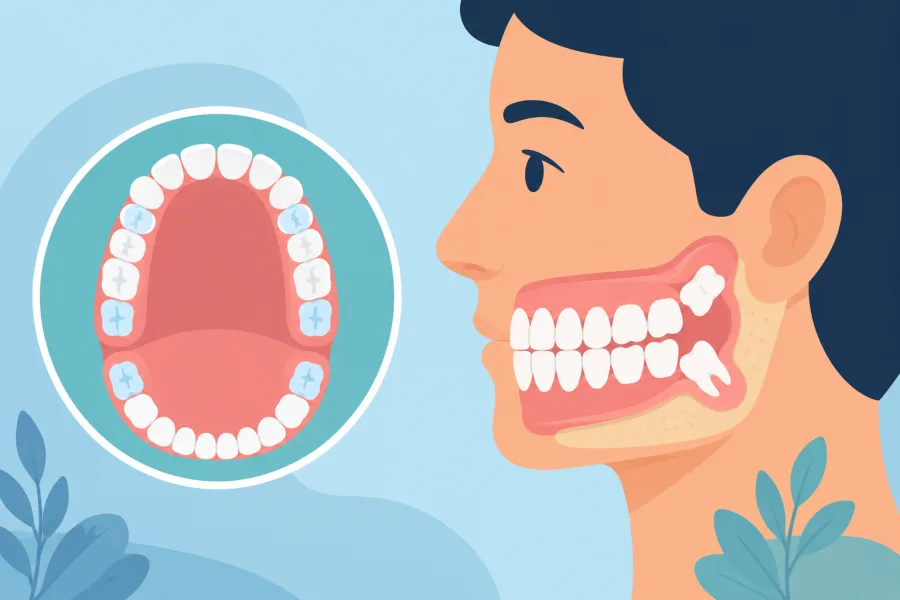
Most adults grow up hearing that humans are equipped with four wisdom teeth, one in each posterior quadrant of the mouth. However, when patients receive comprehensive dental X-rays in their late teens, many are surprised to discover they have only two, three, or even zero third molars. In rarer cases, individuals may even develop five or more third molars. The actual number of wisdom teeth varies widely across populations, driven by human genetics and craniofacial evolution.
At Oral and Facial Surgery of Miami, board-certified oral and maxillofacial surgeon Dr. Johanny Caceres frequently identifies numerical dental variations on high-definition 3D imaging. Understanding how many wisdom teeth you have, why anatomical variations happen, and how missing or extra teeth affect your bite is essential for safeguarding your lifelong oral health.
Numerical Variations: From Zero to Hyperdontia (Supernumerary Molars)
While having four third molars remains the textbook baseline, human dental development exhibits remarkable diversity:
- Four Wisdom Teeth (Most Common): Approximately 55% to 65% of adults develop all four third molars (two maxillary upper teeth and two mandibular lower teeth).
- Congenital Agenesis (Hypodontia): Up to 35% of people fail to develop at least one wisdom tooth. It is common for an individual to have three, two, or just a single third molar. In addition, roughly 10% to 15% of the population never forms any wisdom teeth at all.
- Supernumerary Teeth (Hyperdontia): In roughly 1% to 2% of the population, dental lamina development overshoots, forming fifth or sixth molars known as paramolars or distomolars. These tiny extra teeth can cause impactions and crowd healthy dentition.
| Tooth Count Variation | Population Frequency | Clinical Management |
|---|---|---|
| All Four Teeth Present | 55% to 65% of adults | Simultaneous extraction under IV sedation prevents future impaction |
| Partial Agenesis (1 to 3 Teeth) | 20% to 25% of adults | Targeted extraction of present teeth to prevent supra-eruption |
| Complete Agenesis (Zero Teeth) | 10% to 15% of adults | No surgical intervention required; routine dental checkups continue |
| Supernumerary (5+ Teeth) | 1% to 2% of adults | Surgical removal of extra molars to prevent cyst formation |
Genetic Drivers and Evolutionary Reductions in Jaw Architecture
Why are so many modern humans missing their third molars? Anthropological and genetic studies point to an evolutionary adaptation known as the reduction of the masticatory apparatus. Thousands of years ago, early hominids consumed coarse, uncooked diets rich in raw roots, tough fibrous plants, and uncooked meat. This rigorous chewing required powerful, broad jaws and three massive sets of grinding molars.
With the discovery of fire, cooking, and modern agriculture, human diets softened dramatically. Over generations, reduced chewing stimulation led to smaller human jawbones. However, the genetic coding governing tooth size did not shrink at the exact same rate. In response, modern humans frequently experience third molar impactions, while specific regulatory gene mutations (including the Pax9 and Msx1 genes) have begun eliminating third molar tooth buds entirely from the human genome.
Why Having Fewer (or Zero) Wisdom Teeth Does Not Prevent Other Oral Issues
Patients who have only one or two wisdom teeth often assume they are off the hook for oral surgery. However, an unbalanced number of third molars can actually create unique functional complications:
- Supra-Eruption: If an upper wisdom tooth is present but the opposing lower wisdom tooth is missing, the upper tooth will slowly over-erupt over time because there is no contact surface to stop its downward movement. Eventually, the elongated tooth impacts into the lower gum tissue or cheek, causing painful ulcerations.
- Food Impaction and Caries: A lone, partially erupted third molar acts as an isolated plaque reservoir, trapping bacteria against the back of the second molar and driving hidden interproximal decay.
- Bite Interference: Mispositioned single third molars can create prematurities during chewing cycles, triggering muscle spasms and temporomandibular joint (TMJ) discomfort.
Comprehensive 3D Radiographic Assessment at OFS Miami
You cannot determine how many wisdom teeth you have simply by looking into a bathroom mirror. Many third molars remain completely un-erupted beneath bone for decades. At our practice, Dr. Johanny Caceres uses low-dose 3D Cone Beam Computed Tomography (CBCT) to inspect your jaw anatomy in high resolution.
Whether you have four impacted teeth requiring simultaneous outpatient extraction or an asymmetric lone molar causing bite irritation, our surgical team provides individualized care with gentle IV sedation.
Find out your precise third molar count and protect your dental alignment. Contact Oral and Facial Surgery of Miami today at (305) 552-1193 or book your consultation online today.