
Tooth Extraction vs Root Canal: Which Option Works Best for Your Smile?
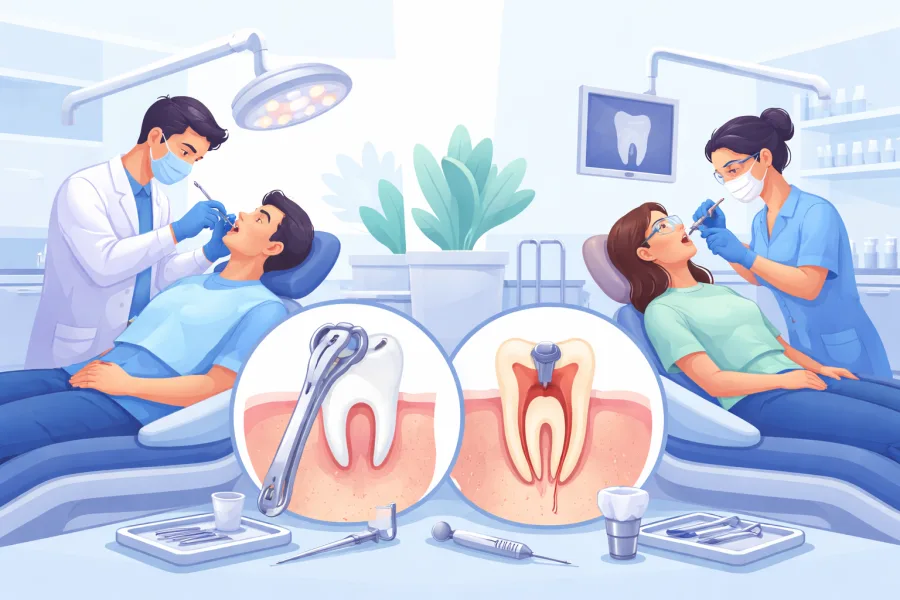
When faced with a deeply decayed, fractured, or infected tooth, patients are often presented with a fundamental clinical dilemma: should they attempt to save the tooth with an endodontic root canal, or should they proceed with a surgical tooth extraction and dental implant? Both treatment modalities represent modern, scientifically proven solutions, but each serves distinctly different biological objectives. Choosing the correct approach depends on remaining tooth structure, periodontal health, and long-term oral stability.
At Oral and Facial Surgery of Miami, board-certified oral and maxillofacial surgeon Dr. Johanny Caceres evaluates complex dental cases alongside general dentists and endodontists. Understanding the clinical trade-offs between endodontic tooth retention and surgical extraction followed by implant reconstruction empowers patients in Coral Gables and Miami to make confident choices for their dental health.
The Biological Goals of Root Canal Therapy
The primary philosophy of restorative dentistry is saving the natural tooth whenever structurally feasible. A root canal treats the living pulp inside a tooth when it becomes irreversibly inflamed or necrotic due to bacterial invasion. During the procedure, the infected neurovascular pulp tissue is removed, the root canal system is thoroughly disinfected and shaped, and the canal terminus is sealed with biocompatible gutta-percha.
By preserving the natural tooth, you retain your natural periodontal ligament. This microscopic ligament contains proprioceptive sensory fibers that allow you to feel delicate biting pressure and chew with natural physiological feedback. After endodontic treatment, a protective crown is placed to shield the tooth from fracture. When the underlying tooth root is structurally sound and supported by healthy jawbone, a root canal provides decades of functional performance.
When Surgical Extraction and Dental Implants Are Superior
While saving a natural tooth is desirable, heroic attempts to save a structurally compromised tooth often result in failure, repeated infections, and unnecessary financial expense. If dental decay extends deep below the crest of the alveolar bone, there is insufficient tooth structure to create a stable ferrule effect for a crown. In addition, teeth with vertical root fractures cannot be sealed, as bacteria continuously leak through the crack into the bone.
In these scenarios, surgical extraction combined with socket preservation bone grafting and a dental implant is the clinically superior choice. A titanium or zirconia dental implant replaces both the root and the crown of the missing tooth, integrating directly into the jawbone through osseointegration. Dental implants cannot develop cavities, provide chewing strength matching natural teeth, and halt localized bone resorption permanently.
| Treatment Factor | Root Canal + Crown | Surgical Extraction + Dental Implant |
|---|---|---|
| Biological Foundation | Preserves natural root and periodontal ligament | Replaces root with biocompatible titanium post |
| Structural Requirement | Requires at least 2mm of sound coronal tooth above bone | Requires adequate alveolar bone density and volume |
| Future Decay Vulnerability | Vulnerable to recurrent marginal decay around crown | Completely immune to bacterial dental decay |
| Treatment Timeline | Completed in 1 to 3 visits over several weeks | Extraction, healing, and implant integration over 3 to 6 months |
Comparing Longevity, Cost, and Maintenance
When comparing the financial investment between these options, initial costs can be deceiving. A root canal paired with a post, core buildup, and custom porcelain crown often carries a lower immediate upfront cost than an extraction, bone graft, and dental implant. However, if a tooth with poor structural integrity fails five years after a root canal, the patient ends up paying for the endodontic treatment, crown, and subsequent extraction and implant anyway.
Dental implants boast a long-term clinical success rate exceeding ninety-five percent over twenty-plus years, making them one of the most cost-effective investments in modern medicine. Maintenance requires standard daily brushing and flossing, along with routine professional cleanings to prevent peri-implant inflammation, ensuring your replacement tooth lasts a lifetime.
Expert Restorative Guidance in Coral Gables
Determining whether a compromised tooth can be reliably saved requires advanced diagnostic imaging and experienced clinical judgment. High-resolution 3D cone beam computed tomography allows specialists to inspect root canals for calcified branches, evaluate periodontal bone height, and confirm the absence of vertical fractures.
At Oral and Facial Surgery of Miami, Dr. Johanny Caceres provides honest, comprehensive evaluations to help you make the best decision for your oral health. If your tooth is non-restorable, our surgical center provides gentle extractions, socket preservation grafting, and dental implant placement under comfortable IV twilight sedation. contact our office at (305) 552-1193 or schedule your consultation online.