
Sinus Lift Surgery Explained: What You Need to Know Before Dental Implants
Being told that you need a sinus lift before receiving dental implants can sound unsettling. Many patients worry that the surgeon will be operating inside their nose or that the procedure will cause chronic sinus headaches and breathing issues.
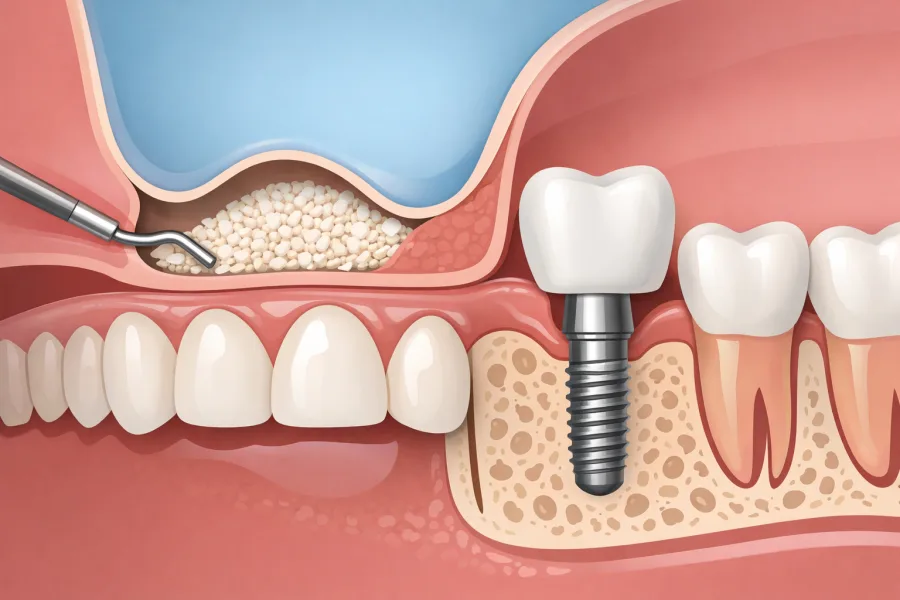
Here is the reassuring clinical reality: a sinus lift (subantral augmentation) is one of the most predictable, well-documented bone enhancement procedures in modern oral surgery. The surgeon never enters your respiratory sinus cavity. Instead, the delicate sinus membrane is gently lifted upward from inside your mouth, creating a sheltered biological pocket where fresh bone can form. Here is an honest, step-by-step look at why upper jawbone disappears, the difference between the two primary surgical techniques, and what recovery actually feels like.
Why Bone Disappears Beneath the Maxillary Sinus
Your maxillary sinuses are naturally occurring, air-filled spaces located directly above your upper back molars and premolars. In a healthy mouth, natural tooth roots extend into a thick layer of alveolar jawbone that acts as a natural floor beneath the sinus cavity.
When upper teeth are lost to decay, fracture, or periodontal disease, this area experiences a unique two-way bone loss phenomenon:
- Crestal Bone Resorption (From Below): Without the daily chewing forces transmitted by natural tooth roots, the alveolar ridge begins to resorb and shrink upward toward the sinus.
- Sinus Pneumatization (From Above): With no roots holding the sinus floor in place, the air-filled sinus cavity naturally expands downward, further hollowing out the remaining jawbone.
Standard dental implants require roughly 8 to 10 millimeters of solid vertical bone height to achieve stable long-term osseointegration. If you have only 2 to 5 millimeters of bone remaining, attempting to place an implant without a sinus lift would risk penetrating the sinus lining, leading to implant failure and chronic inflammation.
The Two Surgical Approaches: Crestal vs. Lateral Window
Using low-dose 3D cone-beam CT imaging, your oral surgeon evaluates your exact bone height and selects one of two specialized techniques:
- The Crestal Approach (Internal Sinus Lift): Recommended when you already have 5 to 7 millimeters of natural bone and only need 2 to 3 millimeters of additional height. The surgeon accesses the sinus floor through the exact same small osteotomy channel prepared for the implant. Using specialized instrument taps or hydraulic pressure, the bone floor is elevated gently from within, bone graft granules are inserted, and the dental implant is frequently placed during the very same visit.
- The Lateral Window Approach (Direct Sinus Augmentation): Required when severe bone loss leaves less than 4 to 5 millimeters of natural bone. The surgeon creates a small, precise micro-window in the cheek side of the upper jawbone. Using delicate instruments, the thin Schneiderian membrane is visualized and lifted upward like a tent, and a generous volume of bone graft material is packed securely beneath it.
What the Surgical Appointment and Sensation Feel Like
Patients are consistently relieved by how manageable sinus lift surgery actually is. The procedure takes approximately 45 to 60 minutes in our surgical suite:
- Complete Numbing and Sedation: The entire upper jaw is numbed with long-acting local anesthetic. For anxious patients, light intravenous conscious sedation provides total relaxation and amnesia so you feel zero stress or pain during the appointment.
- Ultrasonic Precision: Modern oral surgeons use gentle piezoelectric surgical devices that cut hard bone with micro-vibrations while leaving delicate soft tissues (like the sinus lining) completely unharmed.
- Suturing: The site is closed with fine dissolvable stitches, and you can return home comfortably the same day.
Post-Operative Precautions and Healing Milestones
Because the bone graft sits immediately adjacent to your nasal sinuses, protecting the healing site from pressure changes during the first 10 to 14 days is essential:
- Do Not Blow Your Nose: Blowing your nose creates strong positive pressure inside the sinus cavity that can dislodge the graft granules. If your nose feels runny, dab it gently with a soft tissue.
- Sneeze With Your Mouth Open: If you feel a sneeze coming on, keep your mouth open to let the pressure escape freely rather than forcing it through your nasal airways.
- Avoid Suction and Straining: Do not drink through straws, smoke, or engage in heavy weightlifting for at least one week.
Mild cheek swelling and slight nasal congestion are normal for 3 to 4 days and resolve quickly with cold compresses and prescribed decongestants. Over the next 4 to 6 months, your body transforms the graft scaffold into solid, living bone, creating an unshakeable foundation for your permanent dental implants.
Advanced Sinus Lift Surgery in Coral Gables
Severe bone loss in your upper jaw does not mean you are disqualified from having permanent, beautiful dental implants. At Oral & Facial Surgery of Miami, board-certified oral and maxillofacial surgeon Dr. Johanny Caceres performs advanced sinus augmentations using 3D digital planning to ensure maximum safety, comfort, and long-term success.
If you have missing upper molars or have been told in the past that you lack enough bone for implants, let our experienced surgical team evaluate your options. Call Oral and Facial Surgery of Miami today at (305) 552-1193 or request a consultation online.