
Are Wisdom Teeth Useful or Evolutionary Leftovers?
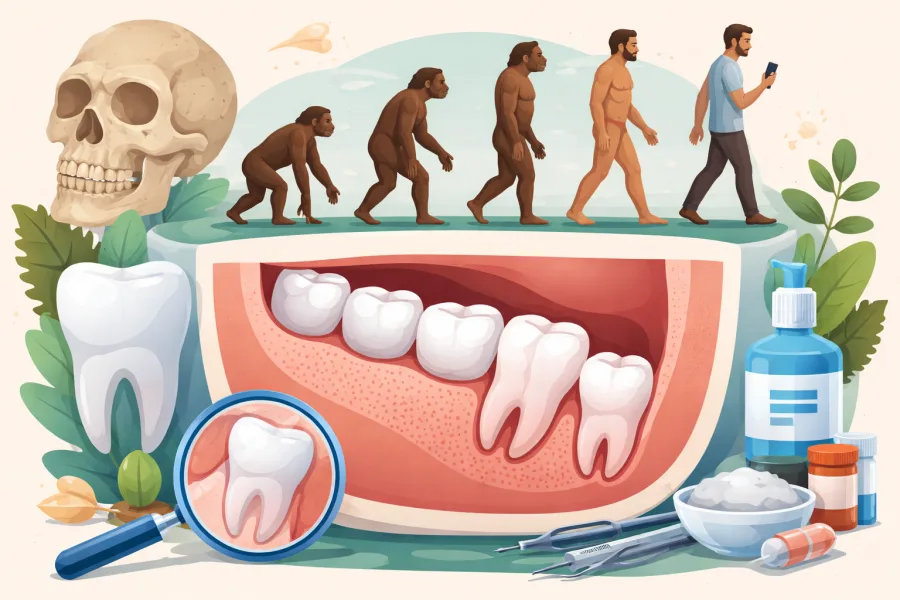
Third molars, commonly called wisdom teeth, occupy an intriguing crossroads between human evolutionary anthropology and modern surgical dentistry. Many patients wonder why human biology programmed third molars to develop late in adolescence only to cause impaction, acute infections, and dental crowding that routinely require surgical extraction. Are wisdom teeth genuinely useful functional assets in contemporary oral health, or are they vestigial evolutionary leftovers whose original biological purpose has long since expired?
At Oral & Facial Surgery of Miami, board-certified oral and maxillofacial surgeon Dr. Johanny Caceres frequently explains the evolutionary mechanics of third molars to patients navigating treatment decisions. Understanding why our ancestors required heavy third molars and why modern jaws struggle to accommodate them clarifies why prophylactic surgical care is so frequently recommended.
1. Paleolithic Utility: Why Ancient Hominids Depended on Third Molars
To understand the functional origins of wisdom teeth, we must examine the physical environment of ancient hominid ancestors dating back hundreds of thousands of years. Early human diets consisted almost entirely of coarse, fibrous, uncultivated vegetation, fibrous roots, raw nuts, seeds, and uncooked game meat. Processing these tough, unyielding foods required massive occlusal grinding power.
Anthropological fossils demonstrate that ancient hunter-gatherers possessed broad, elongated dental arches and robust mandibular frames. In this anatomical landscape, third molars were indispensable tools. Because early humans lacked culinary cutlery, food processing, or oral hygiene routines, natural grit and abrasive stones in food wore down enamel rapidly. Premature loss of first and second molars to heavy attrition was common by early adulthood. Third molars erupted between the ages of 17 and 25 to drift forward into empty spaces, replenishing lost masticatory surface area and ensuring survival.
2. The Vestigial Shift: Dietary Softening, Cooking, and Craniofacial Retraction
The evolutionary trajectory of the human skull changed dramatically with two cultural revolutions: the mastery of fire for cooking food and the agricultural revolution. Thermal cooking breaks down tough plant cellulose and softens animal protein fibers, drastically reducing the mechanical forces required for mastication. Agricultural milling and food storage further eliminated abrasive grit from daily sustenance.
As chewing stress diminished over millennia, natural selection favored smaller, lighter facial skeletons. Massive jawbones and heavy chewing muscles were no longer evolutionary advantages that conserved energy. Over thousands of generations, human craniofacial architecture experienced orthognathic retraction: the lower face flattened, the dental alveolar arches shortened, and braincase volume expanded. However, while human jaw length contracted substantially, the genetic blueprint encoding 32 permanent teeth remained largely unchanged, creating an anatomical space mismatch.
| Biological Dimension | Ancient Hominid Ancestors | Modern Human Anatomy |
|---|---|---|
| Dietary Texture | Raw, coarse, fibrous, abrasive, and uncultivated foods | Thermally cooked, soft, processed, and easily chewed foods |
| Mandibular Arch Length | Elongated with ample retromolar space behind 2nd molars | Shortened and compact; third molar space severely restricted |
| Third Molar Function | Essential grinding surface; natural functional replacement | Largely non-functional vestigial organ with high impaction rate |
| Dental Attrition Rate | Severe interproximal and occlusal wear creating extra space | Minimal tooth wear; dental arches retain tight interproximal contacts |
| Primary Health Outcome | Unobstructed vertical eruption; functional survival value | High incidence of pericoronitis, cysts, and 2nd molar root resorption |
3. The Modern Mismatch: Why Vestigial Teeth Create Severe Clinical Pathology
In contemporary human anatomy, third molars fit the biological definition of a vestigial organ: a structure that has lost all or most of its ancestral function through evolutionary change, similar to the human appendix or coccyx. When a vestigial tooth attempts to erupt into a dental arch that has no physical space to receive it, severe clinical pathology frequently follows.
Third molars frequently become stuck horizontally, mesioangularly, or vertically in bone (impaction). When partially erupted, an opercular gum flap traps virulent oral anaerobes, causing chronic pericoronitis and bad breath. Because third molars are tucked so deeply at the back of the jaw, proper brushing and flossing are nearly impossible, creating a breeding ground for rampant decay that destroys the adjacent healthy second molar. In other cases, unerupted follicles form dentigerous cysts, expanding silently and hollowing out large sections of mandibular bone.
4. Functional Retention vs. Prophylactic Extraction: Specialist Care at OFS Miami
Can wisdom teeth ever be useful today? Yes, in rare clinical scenarios. If a patient possesses a naturally spacious jaw, if all four third molars erupt completely vertically with healthy surrounding keratinized gum tissue, and if the patient can clean them meticulously every day, wisdom teeth can function alongside other molars. In select cases, an erupted third molar can even serve as an anchor for restorative dental prosthetics if a second molar was lost early in life.
However, clinical research indicates that over 80 percent of modern individuals develop at least one impacted or non-functional third molar. At Oral & Facial Surgery of Miami, Dr. Johanny Caceres uses 3D Cone Beam Computed Tomography (CBCT) to differentiate between rare, functional wisdom teeth and non-functional vestigial teeth that threaten long-term oral health. Removing problematic third molars under comfortable IV sedation permanently protects your dental alignment, preserves neighboring molars, and eliminates recurrent infections.
If you are questioning whether your wisdom teeth are serving a healthy purpose or setting the stage for future complications, our surgical team is here to assist. Contact Oral & Facial Surgery of Miami today at (305) 552-1193 or book your consultation online for an expert anatomical evaluation.