
Signs Your Wisdom Tooth Is Growing the Wrong Way
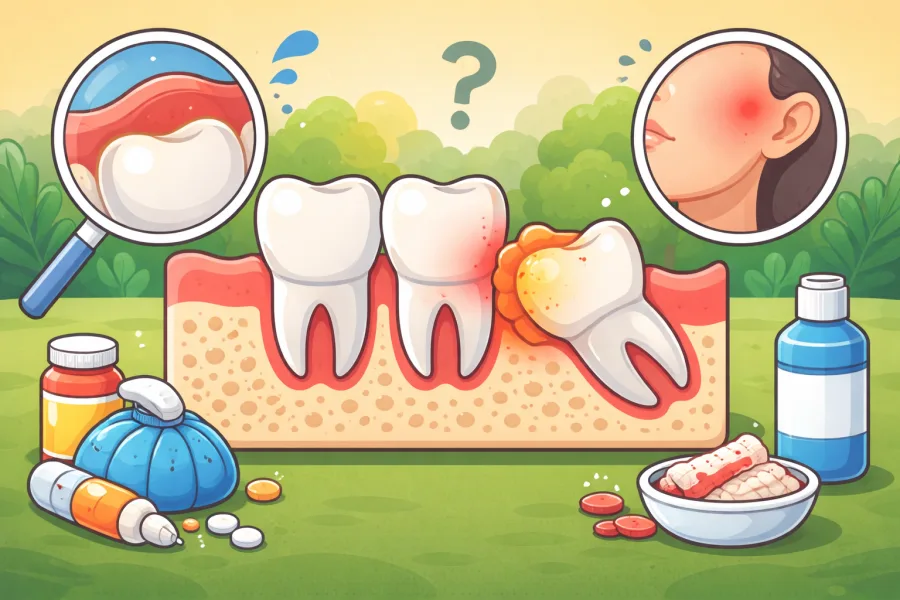
Third molars are notorious for unpredictable eruption paths. Unlike other teeth that follow guided developmental tracks through the jaw, wisdom teeth frequently run out of space as they attempt to emerge. Instead of erupting vertically into a functional bite, they tilt forward, angle backward toward the throat, or grow completely sideways against neighboring molars. While some misaligned wisdom teeth cause immediate pain, others grow abnormally for years without obvious distress.
At Oral and Facial Surgery of Miami, board-certified oral and maxillofacial surgeon Dr. Johanny Caceres frequently diagnoses and corrects third molar impactions. Learning to identify the anatomical trajectories of malpositioned teeth and recognizing their subtle clinical symptoms empowers you to seek timely treatment before irreversible damage occurs.
The Four Impaction Angles: Mesial, Horizontal, Vertical, and Distal
Oral surgeons classify misaligned wisdom teeth based on their spatial orientation relative to the dental arch and the adjacent second molar:
- Mesioangular Impaction (Most Common): The tooth is tilted forward toward the front of the mouth, pushing its crown directly into the back surface of the second molar. This angle creates an un-cleanable food trap beneath the gumline.
- Horizontal Impaction: The tooth lies completely flat at a 90-degree angle, buried beneath bone or gum tissue. As it develops, the crown burrows directly into the root trunk of the neighboring molar.
- Distoangular Impaction: The tooth is angled backward toward the rear of the jaw and ascending ramus bone. These teeth are notoriously difficult to extract because their roots curve forward toward the mandibular canal.
- Vertical Impaction: The tooth is positioned upright in a normal vertical direction but remains trapped beneath a dense bony shelf or thick fibrous gum tissue because the dental arch lacks sufficient length.
| Impaction Angle | Direction of Growth | Primary Clinical Danger |
|---|---|---|
| Mesioangular | Tilted forward at 45 degrees into second molar | Cervical cavities, interproximal bone craters, pericoronitis |
| Horizontal | Lying completely sideways at 90 degrees | External root resorption of adjacent tooth, mandibular bone thinning |
| Distoangular | Tilted backward into the ascending jaw ramus | Deep bone entrapment, severe trismus, proximity to nerve trunk |
| Vertical Trapped | Straight orientation blocked by overlying bone | Chronic operculum infection, inability to fully break through gum |
Physical Symptoms of Malpositioned Third Molars
When a wisdom tooth erupts off-course, it communicates its misdirection through several characteristic physical indicators:
- Cheek Biting and Mucosal Ulcerations: Buccally displaced upper wisdom teeth flare outward toward the cheek. As you chew, your cheek tissue gets repeatedly caught between opposing teeth, causing painful raw lacerations.
- Pericoronal Flap Inflammation (Pericoronitis): Partially erupted teeth leave a loose gum flap (operculum) where bacteria and food collect. The flap becomes swollen, purulent, and tender to the slightest touch.
- Jaw Stiffness and Restricted Mouth Opening (Trismus): Inflammation spreading into the nearby masseter and medial pterygoid chewing muscles makes opening your mouth wider than an inch excruciatingly difficult.
- Referred Headaches and Ear Pressure: Pressure against the mandibular nerve triggers throbbing pain that radiates upward into your temples, behind your eyes, and into the ear canal.
Collateral Damage to Adjacent Teeth and Periodontal Bone
The greatest threat posed by a misaligned wisdom tooth is not the discomfort it causes in the moment, but the irreversible damage it inflicts on neighboring teeth. When a tooth grows sideways into the second molar, it exerts continuous pressure on the root. In response, osteoclasts dissolve the second molar's root cementum, a condition known as external root resorption.
Additionally, the gap between a tilted third molar and the second molar is impossible to clean with dental floss. Anaerobic bacteria thrive in this dark crevice, silently hollowing out a massive cavity on the back of the second molar root. By the time a patient realizes something is wrong, both the wisdom tooth and the essential second molar may be lost.
Precision 3D Diagnostics and Gentle Removal at OFS Miami
Because abnormal growth occurs beneath the gumline, high-resolution 3D Cone Beam Computed Tomography (CBCT) is vital for accurate diagnosis. At our practice, Dr. Johanny Caceres maps the exact 3D trajectory of your third molars, verifying root proximity to the inferior alveolar nerve before planning extraction.
our surgical suite provides a comfortable, peaceful setting where impacted teeth are gently sectioned and delivered under soothing IV sedation. You sleep comfortably through the entire visit and awaken ready to begin a smooth recovery.
Do not wait until a misaligned wisdom tooth damages neighboring teeth. Contact Oral and Facial Surgery of Miami today at (305) 552-1193 or reserve your surgical consultation online today.