
Why Choose a Specialist for Impacted Wisdom Teeth?
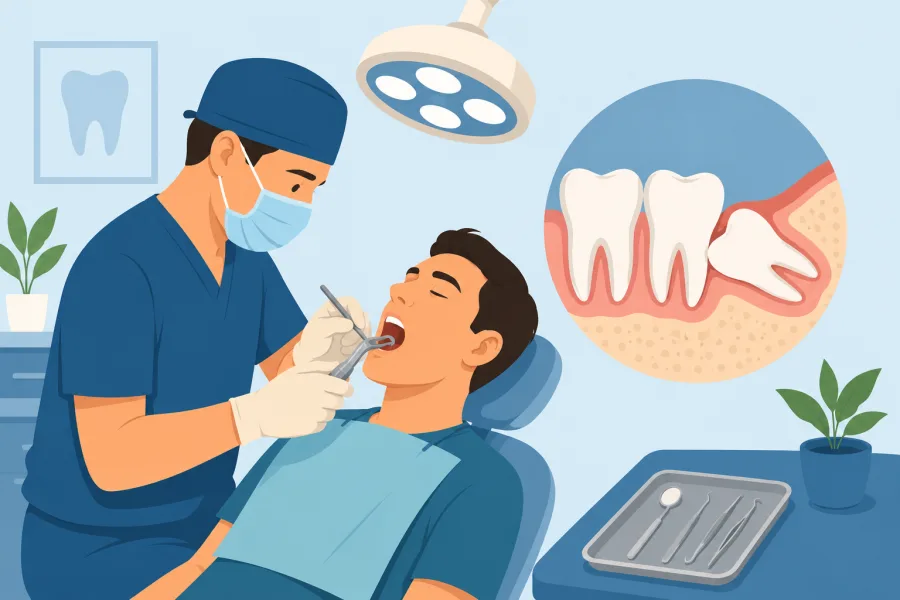
When you learn that your third molars are impacted, one of the most important decisions you will make is deciding who will perform the surgery. Many general dental offices offer wisdom tooth extractions as part of their routine service menu. However, removing an impacted tooth trapped beneath dense jawbone or growing sideways against adjacent roots is not a routine tooth pulling; it is a delicate maxillofacial surgical procedure.
Choosing a board-certified oral and maxillofacial surgeon (OMFS) ensures that your care is managed by a specialist with years of hospital-based surgical and anesthesia residency training. At Oral & Facial Surgery of Miami, Dr. Johanny Caceres combines advanced 3D volumetric diagnostics, hospital-grade intravenous sedation, and bone-preserving microsurgical techniques to deliver the safest, most comfortable patient experience possible in Coral Gables.
1. The Training Gap: General Dentistry vs. Oral and Maxillofacial Surgery
All oral surgeons begin their careers as general dentists, completing four years of standard dental school. While a general dentist is an expert in restorative dentistry, routine hygiene, crowns, and simple extractions of loose teeth, their formal surgical training during dental school is necessarily limited.
An oral and maxillofacial surgeon, by contrast, completes an additional four to six years of intensive hospital-based surgical residency following dental school. During this rigorous residency, oral surgeons train alongside medical doctors in general surgery, trauma surgery, plastic surgery, emergency medicine, and anesthesiology. They perform thousands of complex surgical extractions, manage facial bone fractures, correct jaw deformities, and master the surgical anatomy of cranial nerves, deep facial vessels, and airway management.
| Clinical Domain | General Dental Clinic | Board-Certified Oral Surgeon (OMFS) |
|---|---|---|
| Post-Graduate Surgical Residency | None; surgical knowledge comes from weekend continuing education seminars. | 4 to 6 years of full-time, hospital-based surgical and medical residency training. |
| Sedation & Anesthesia Capabilities | Primarily local numbing and mild oral sedatives (Valium) or nitrous oxide ("laughing gas"). | Comprehensive intravenous (IV) deep sedation and general anesthesia with multi-lead monitoring. |
| Diagnostic Imaging Technology | Standard 2D panoramic X-rays that flatten anatomical structures into a single plane. | In-office 3D Cone Beam CT (CBCT) providing sub-millimeter volumetric mapping of nerve paths. |
| Managing Severe Impaction Risks | Higher risk of root fracture, cortical bone trauma, or aborted procedures requiring mid-surgery referral. | Expertise in microsurgical sectioning, piezosurgery, and elective coronectomy for nerve protection. |
2. Diagnostic Precision: Why 3D CBCT Imaging Is Vital for Impactions
When a wisdom tooth is impacted, the biggest surgical risk involves the inferior alveolar nerve, which runs through a bony canal in the lower jaw directly beneath third molar roots. This nerve supplies feeling to your lower lip, chin, and front teeth.
Standard 2D panoramic X-rays common in general dental practices cannot show depth. On a 2D film, a tooth root often appears to cross directly over the nerve, but it is impossible to determine whether the root is passing safely in front of the nerve, behind the nerve, or if the nerve canal is actually compressed between the roots.
At Oral & Facial Surgery of Miami, Dr. Johanny Caceres uses in-office low-dose 3D Cone Beam Computed Tomography (CBCT). This scan allows Dr. Caceres to rotate your jawbone in three dimensions on a high-definition monitor, measuring the exact distance between the tooth roots and the sensory nerve canal down to a fraction of a millimeter. This eliminates surgical guesswork and prevents permanent nerve injury.
3. Anesthesia and Patient Comfort: The IV Sedation Advantage
Dental anxiety is one of the most common reasons patients postpone needed wisdom tooth care. Undergoing surgical bone removal while wide awake under only local anesthesia can be an exhausting sensory ordeal filled with pressure, vibration, and surgical sounds.
Oral and maxillofacial surgeons are the only dental specialists legally certified and qualified through hospital anesthesia rotations to administer intravenous (IV) deep conscious sedation and general anesthesia in an outpatient setting. In our fully accredited Coral Gables surgical facility, you are placed on continuous ECG cardiac, blood pressure, end-tidal CO2, and pulse oximetry monitors.
Once IV sedation begins, you drift into a peaceful twilight sleep. You feel zero anxiety, experience no pain, and wake up after the surgery is completely finished with no memory of the procedure. For anxious patients, this transforms what could have been a terrifying experience into a completely relaxing nap.
4. Nerve Preservation Techniques: When to Perform a Coronectomy
What happens when 3D imaging reveals that a deeply impacted wisdom tooth root is directly wrapped around the inferior alveolar nerve? In an inexperienced setting, attempting to elevate that tooth can tear or severely bruise the nerve trunk, leading to permanent numbness in the lower lip and chin.
An experienced oral surgeon has the specialized training to perform an elective coronectomy. In this advanced procedure, Dr. Caceres delicately removes the crown of the wisdom tooth (which causes the impaction, gum infections, and pressure against neighboring molars) while intentionally leaving the healthy, uninfected root tips safely undisturbed in the bone. Over time, bone regenerates over the submerged roots, permanently protecting the nerve bundle while completely resolving the patient's symptoms.
Your oral health and facial nerve safety are too important to compromise. If you or a family member has been diagnosed with impacted wisdom teeth, trust your smile to a board-certified surgical specialist. Contact Dr. Johanny Caceres at Oral & Facial Surgery of Miami by calling (305) 552-1193 or book your consultation online today in Coral Gables.