
Can Impacted Wisdom Teeth Cause Front Teeth Discomfort?
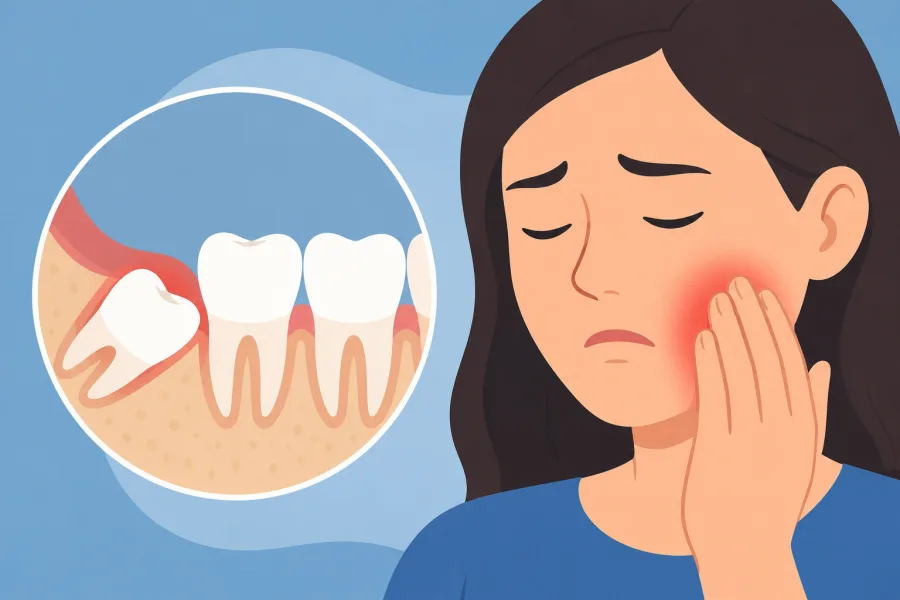
When a third molar acts up, most people expect throbbing soreness confined strictly to the rear corners of the jaw. Yet one of the most puzzling and alarming symptoms patients report is pain that travels forward, making their front incisors and canines feel achy, tender, or unusually sensitive to pressure. You might inspect your front teeth in the mirror, finding zero cavities, chips, or gum redness, yet the persistent forward ache remains impossible to ignore.
This clinical phenomenon is not in your head. The mouth operates as an interconnected neuromuscular and hydraulic system governed by the trigeminal nerve. At Oral & Facial Surgery of Miami, board-certified oral surgeon Dr. Johanny Caceres regularly evaluates patients whose anterior dental pain actually originates from deeply impacted posterior wisdom teeth. Understanding how nerve pathways and arch forces interact helps demystify your symptoms and guides you toward lasting relief.
1. Neuroanatomy of Referred Pain: The Trigeminal Convergence
The human body is remarkably efficient at routing sensory signals, but this shared wiring occasionally confuses the brain's sensory cortex. All sensory perception from your teeth, gums, and jaws is conducted through the fifth cranial nerve, known as the trigeminal nerve.
The Mandibular Division (CN V3): Sensory fibers from your lower wisdom teeth enter the inferior alveolar nerve canal, traveling alongside nerve fibers originating from your bicuspids and incisors. When severe inflammation, bacterial toxins, or bony impaction persistently stimulate the nerve fibers around a lower third molar, intense electrical impulses overwhelm the local synaptic pathway.
Sensory Convergence in the Brainstem: These sensory inputs converge at the spinal trigeminal nucleus in the brainstem, where second-order neurons receive signals from multiple tooth roots across the dental quadrant. Because your cerebral cortex is accustomed to processing high-frequency sensory input from your front teeth (which you use constantly to bite and touch food), the brain can misproject the painful sensory signal forward, interpreting posterior wisdom tooth distress as an acute ache in your healthy front incisors.
| Diagnostic Factor | Referred Wisdom Tooth Discomfort | Primary Front Tooth Pathology |
|---|---|---|
| Visual & Tactile Exam | Front teeth and gingival margins look completely healthy; zero decay, cracks, or loose enamel. | Visible cavities, enamel wear, chips, or localized recession along the cervical margin. |
| Nature of the Sensation | Deep, diffuse, pressure-like ache; pain shifts or radiates between front incisors and rear jaw. | Sharp, pinpoint pain localized strictly to a single front tooth when tapped or touched. |
| Thermal Sensitivity | Cold air or drinks produce no lingering pain when applied directly to individual front teeth. | Prolonged, hypersensitive zinging response to cold or hot liquids lasting over 10 seconds. |
| Impact of Clenching | Chewing tough foods triggers posterior jaw fullness that amplifies anterior discomfort. | Biting down directly on the affected front tooth produces sharp, localized tenderness. |
2. Arch Biomechanics: How Tight Contacts Transmit Anterior Tension
Beyond neurological cross-talk, physical force vectors also play a major role in forward-radiating pain. Wisdom teeth naturally exert a forward and upward eruption vector known as mesial drift. When a large third molar attempts to erupt into an already crowded jaw, it acts like a wedge driven into the back of the dental arch.
This continuous mechanical pressure does not stop at the neighboring second molar. Teeth are suspended inside their bony sockets by microscopic shock absorbers known as periodontal ligament (PDL) fibers. As the rear molar is compressed, physical tension is transmitted through tight proximal contact points forward along the entire dental arch, all the way to the central incisors.
This arch-wide compression strains the sensitive mechanoreceptors inside the periodontal ligaments of your front teeth. Patients frequently describe this sensation as a "tightness" or feeling as if their front teeth are suddenly being squeezed into a vice.
3. Occlusal Interference and Myofascial Trigger Points
When a wisdom tooth erupts at an abnormal tilt, even a tiny cusp piercing the gum can create a premature occlusal contact, meaning it hits the opposing tooth before the rest of your bite closes naturally.
To avoid biting down painfully on this high spot, your brain instinctively alters your chewing stroke. Your jaw shifts slightly to one side, forcing the powerful masseter, temporalis, and lateral pterygoid muscles to contract asymmetrically. Over several days or weeks, these chronically fatigued muscles develop hyperirritable nodules called myofascial trigger points.
Trigger points in the anterior temporalis muscle and the superficial masseter consistently refer deep, burning pain directly into the upper and lower front teeth. Treating your front teeth with dental fillings or sensitivity toothpastes will completely fail to resolve this discomfort, because the true driver is muscular splinting initiated by the rear third molar.
4. Precision Diagnosis and Definitive Treatment in Coral Gables
Distinguishing between primary anterior dental pathology and referred wisdom tooth pain requires comprehensive maxillofacial diagnostics. At Oral & Facial Surgery of Miami, Dr. Johanny Caceres utilizes low-dose 3D Cone Beam Computed Tomography (CBCT) to evaluate your entire craniofacial anatomy in high definition.
A 3D CBCT scan allows Dr. Caceres to trace the exact relationship between the wisdom tooth roots, the mandibular nerve canal, and adjacent molars, while simultaneously ruling out hidden root fractures or periapical lesions on your anterior teeth. If an impacted third molar is confirmed as the source of referred nerve pain or mechanical arch crowding, minimally invasive extraction under gentle IV twilight sedation completely removes the pathological pressure.
Once the offending third molar is extracted and the dental arch decompresses, trigeminal hypersensitivity subsides and anterior tooth discomfort typically resolves completely within days. If you are struggling with unexplained front tooth soreness, jaw tension, or rear gum swelling, schedule an expert evaluation with Dr. Johanny Caceres. Call Oral & Facial Surgery of Miami at (305) 552-1193 or book your consultation online today.