
How Stress Affects Your Teeth (And What You Can Do About It)
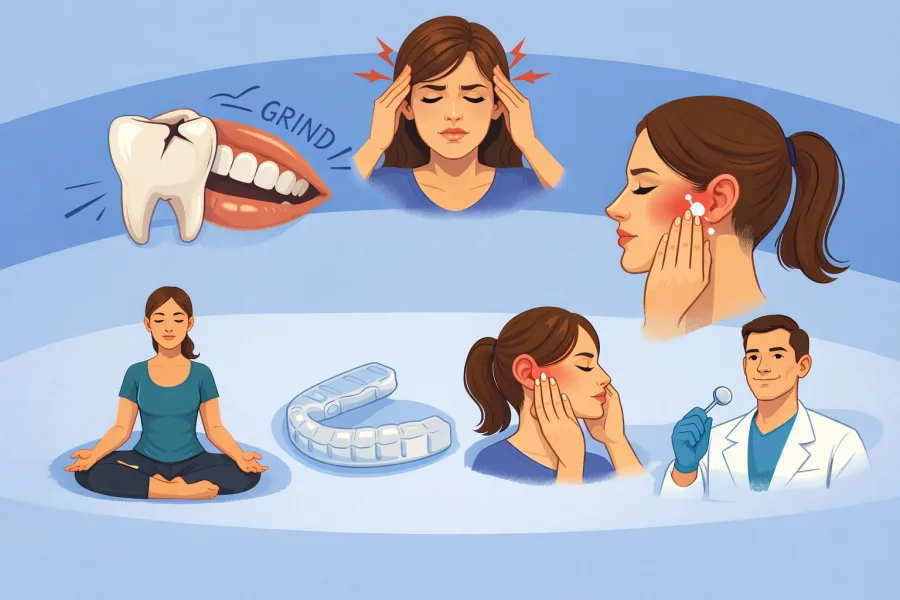
Stress manifests physically in subtle and surprising ways. While many people recognize shoulder tension or gastrointestinal distress, few realize that psychological stress often exerts its most destructive physical impact directly inside the mouth. Chronic stress triggers nocturnal clenching and rhythmic grinding of the teeth, a condition known clinically as bruxism.
Because sleep bruxism occurs unconsciously, patients often spend months or years wondering why they wake up with dull morning headaches, aching jaw joints, unexplained tooth sensitivity, or cracked dental restorations. Left unaddressed, chronic grinding breaks down enamel, causes premature tooth loss, and damages the delicate temporomandibular joints (TMJ). Here is what occurs mechanically under stress, how to recognize the damage, and the treatments oral surgeons use to protect your jaw.
1. The Biomechanics of Bruxism: Neuromuscular Stress and Extreme Occlusal Forces
When the sympathetic nervous system stays constantly activated by stress, elevated circulating cortisol stimulates the trigeminal motor nucleus in the brainstem. This triggers involuntary spasms of the primary masticatory muscles: the masseters, temporalis, and pterygoids.
During normal daytime chewing, teeth exert approximately 20 to 40 pounds of pressure per square inch, and teeth only make direct physical contact for minutes each day. During nocturnal sleep bruxism, however, protective neurological reflexes turn off. The masticatory muscles can clamp down with sustained force exceeding 250 to 300 pounds per square inch:
- Enamel Attrition: Constant lateral shearing grinds down the protective enamel layer, flattening cusps and exposing yellowish, porous dentin underneath.
- Abfraction Lesions: Extreme lateral flexure of the tooth crown causes microscopic enamel prisms at the gumline to pop off, creating deep notched grooves that look like toothbrush wear.
- Cracked Tooth Syndrome: Unrelenting hydraulic pressure propagates microscopic fracture lines down into the tooth root, eventually splitting teeth and necessitating surgical extraction.
2. From Muscle Tension to Joint Degeneration: TMJ Internal Derangement
Bruxism does not stop at dental wear. The jaw hinges on two complex structures located just in front of each ear canal: the temporomandibular joints (TMJ). Each joint contains a fibrocartilaginous articular disc that cushions the condylar head during movement. Chronic clenching forces this delicate joint system out of balance:
| Stage of TMJ Strain | Internal Joint Pathology | Patient Symptoms |
|---|---|---|
| Early Myofascial Pain | Trigger points in masseter and temporalis; lactic acid accumulation from prolonged clenching. | Morning tension headaches across temples, facial stiffness, fatigue when eating chewy foods. |
| Disc Displacement with Reduction | Articular disc slips forward when mouth is closed; condyle snaps back onto disc during opening. | Distinct clicking or popping sounds when opening mouth wide or chewing. |
| Disc Displacement without Reduction ("Closed Lock") | Disc permanently bunches in front of condyle, acting as a physical doorstop that blocks joint glide. | Sudden inability to open mouth more than one or two fingers; sharp joint pain radiating into ear. |
| Osteoarthritis & Retrodiscal Fibrosis | Articular disc perforates; bone-on-bone contact causes condylar flattening and osteophyte (spur) formation. | Grating or crunching sensation (crepitus), chronic restricted range of motion, bite changes. |
3. Comprehensive Clinical Management: Nightguards, Botox, and Joint Therapy
Over-the-counter store-bought nightguards are often soft and rubbery. For bruxism sufferers, soft guards act like chewing gum, stimulating the chewing reflex and actually increasing nighttime clenching intensity. Effective clinical management requires specialized interventions:
- Custom Hard Dual-Laminate Occlusal Splints: Fabricated from rigid, high-grade acrylic, custom surgical splints provide an ultra-smooth flat surface. This disengages the posterior occlusion, prevents lateral friction, and allows the jaw muscles to relax into their natural rest position.
- Therapeutic Neuromodulators (Botox for TMJ): Strategic injections of botulinum toxin directly into hyperactive masseter and temporalis muscle bellies temporarily soften the maximum contraction force. You can still speak, smile, and chew normally, but the involuntary grinding force is reduced by up to 70%, stopping joint destruction and relieving chronic headaches.
- TMJ Arthrocentesis: For patients experiencing painful joint clicking or acute jaw locking, an in-office minimally invasive joint lavage washes out inflammatory cytokines (interleukins and prostaglandins), gently expands the joint space, and restores fluid disc mobility.
4. Specialized TMD & Bruxism Care with Dr. Johanny Caceres in Miami
You do not have to live with waking up in pain, enduring daily tension headaches, or watching your teeth wear away. At our practice, board-certified oral and maxillofacial surgeon Dr. Johanny Caceres brings deep hospital surgical training and specialized diagnostic tools to treat complex bruxism and TMJ disorders.
Using high-resolution 3D Cone Beam CT imaging, we assess the precise bony architecture of your condylar heads, measure airway dimensions to rule out sleep-related breathing disorders, and build a personalized rehabilitation strategy at Oral and Facial Surgery of Miami.
If stress and teeth grinding are affecting your quality of life, schedule a specialized evaluation with Dr. Caceres today. Contact Oral and Facial Surgery of Miami at (305) 552-1193 or book your consultation online.