
How Long Do Gums Take to Fully Heal After Surgery?
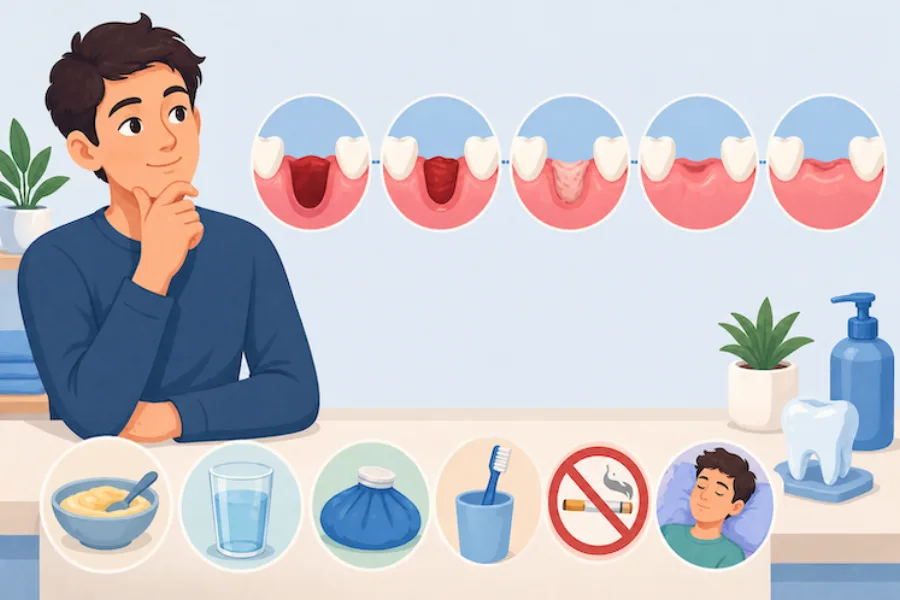
Undergoing an oral surgical procedure, whether a simple extraction, wisdom tooth removal, or dental implant placement, initiates a complex biological wound-healing cascade. Patients naturally want to know when their gums will look and feel completely normal again. While superficial soft tissue closes within a couple of weeks, full cellular remodeling and deep bone maturation take several months.
At Oral and Facial Surgery of Miami, board-certified oral and maxillofacial surgeon Dr. Johanny Caceres emphasizes biological healing milestones over guesswork. Understanding what occurs beneath the surface during each post-operative phase allows you to protect your surgical sites and navigate recovery with confidence.
The Three Biological Phases of Gingival Wound Healing
Gum tissue repair follows three sequential, overlapping biological phases: the inflammatory phase, the proliferative phase, and the remodeling phase. Each stage involves distinct cellular players working to re-establish tissue barrier integrity.
The inflammatory phase begins immediately upon surgical incision and lasts for three to five days. A blood clot forms within minutes, releasing growth factors that summon neutrophils and macrophages to sterilize the wound. Between days four and fourteen, the proliferative phase dominates. Fibroblasts migrate across the socket, depositing new collagen fibers while microscopic capillaries sprout to create pink, healthy granulation tissue. Finally, during the remodeling phase, which continues for several months, collagen reorganizes to form mature, resilient keratinized gingiva.
| Healing Timeline | Cellular & Tissue Activity | Clinical Gum Appearance | Patient Self-Care Protocol |
|---|---|---|---|
| Days 1 to 3 (Hemostasis) | Fibrin meshwork stabilizes; macrophage debridement | Dark red blood clot; surrounding pink swelling | Ice packs, bite on gauze, no straws or spitting |
| Days 4 to 14 (Proliferation) | Angiogenesis, granulation tissue formation, re-epithelialization | Whitish-yellow tissue matrix over socket opening | Warm saline rinses; soft-food diet; gentle brushing |
| Weeks 3 to 6 (Maturation) | Complete mucosal closure; initial osteoid bone deposition | Firm pink gumline; slight indentation in socket ridge | Return to regular brushing and standard diet |
| Months 3 to 6 (Remodeling) | Trabecular bone mineralizes into dense cortical bone | Fully healed, smooth alveolar ridge; stable gum contour | Implant restoration and routine preventative care |
Soft Tissue Epithelialization vs Deep Bone Maturation
A common misunderstanding among patients is assuming that once the surface gum appears closed, healing is one hundred percent finished. In reality, soft tissue and bone heal at markedly different rates.
Epithelial cells migrate from the wound edges toward the center at a rate of approximately 0.5 millimeters per day, bridging the extraction opening within seven to fourteen days. Beneath this superficial gum seal, however, osteoblasts are just beginning the slow process of bone regeneration. Immature woven bone gradually fills the socket over six to eight weeks, requiring three to six months to mineralize into load-bearing lamellar bone capable of anchoring dental implants.
Systemic and Lifestyle Factors That Delay Tissue Repair
The speed and quality of gingival healing depend heavily on systemic health. Uncontrolled diabetes impairs micro-vascular blood flow and blunts macrophage activity, significantly delaying socket closure and elevating infection risks.
Tobacco use and vaping are among the most destructive factors. Nicotine acts as a potent vasoconstrictor, reducing oxygen delivery to granulating tissues by up to forty percent. In addition, the negative physical suction created when inhaling smoke or using drinking straws pulls fragile blood clots from bone, precipitating painful dry socket (alveolar osteitis). Chronic stress, poor sleep, and vitamin deficiencies also impair collagen synthesis.
Advanced Surgical Healing Protocols at OFS Miami
At our practice, Dr. Johanny Caceres uses refined microsurgical techniques that preserve maximum soft tissue and cortical bone. By employing atraumatic extraction instruments and dissolving sutures, our team minimizes tissue trauma and accelerates the healing timeline.
When replacing missing teeth, Dr. Caceres incorporates socket preservation bone grafting and precision dental implants placed under comfortable outpatient IV twilight sedation. With detailed aftercare guidance and close follow-up support, we ensure your gums heal smoothly, comfortably, and beautifully.
Ensure optimal oral surgical healing. Contact Oral and Facial Surgery of Miami at (305) 552-1193 or book your consultation online today.