
Jaw Surgery Recovery Timeline: What Healing Really Looks Like
Corrective jaw surgery (orthognathic surgery) reshapes your bite, airway, and facial structure, but patients often wonder what life looks like the day after surgery. Walking into major facial surgery without a concrete recovery roadmap creates unnecessary anxiety. Many people assume their mouth will be wired shut for months or that pain will be unbearable. In reality, modern surgical techniques, rigid internal fixation with titanium plates, and refined anesthetic protocols have transformed the healing journey into an organized, manageable process.
Whether you are undergoing a Le Fort I maxillary osteotomy, a bilateral sagittal split osteotomy (BSSO) of the lower jaw, or bimaxillary double-jaw surgery, healing follows a predictable biological sequence. Here is what healing looks like week by week, how to manage post-surgical changes, and when to resume your normal lifestyle.
1. Biological Bone Healing and the Critical First 72 Hours
During orthognathic surgery, your oral and maxillofacial surgeon precisely cuts and repositions the maxillary or mandibular bone segments into functional harmony. These segments are then stabilized with biocompatible titanium microplates and tiny screws. This technique, known as rigid internal fixation, has largely eliminated the historical practice of wiring jaws shut. Instead of rigid immobilization, gentle guiding elastics are placed on orthodontic brackets to guide your bite into its new relationship while still allowing you to open your mouth slightly for hygiene and nutrition.
The first 72 hours represent the peak inflammatory response. Understanding what happens biologically during these first three days helps you stay calm and comfortable:
- Peak Facial Edema: Swelling builds progressively and peaks between hours 48 and 72. Your cheeks, lips, and lower face will feel taut and full. This is normal cellular response as your vascular system rushes healing factors to the osteotomy sites.
- Airway and Nasal Congestion: If you underwent upper jaw surgery, sinus membranes will be congested, and mild blood-tinged nasal drainage is common. You must never blow your nose during the first four weeks, as intranasal pressure can force air into facial soft tissues (subcutaneous emphysema). Use saline nasal sprays and a bedroom humidifier instead.
- Elevation and Cold Therapy: Keep your head elevated at a 45-degree angle both day and night. Propping yourself up on two to three pillows or sleeping in a recliner uses gravity to drain lymphatic fluid away from your face. Apply ice packs to your jaw in 20-minute intervals during the first 48 hours to minimize tissue distention.
2. The Week-by-Week Recovery Roadmap
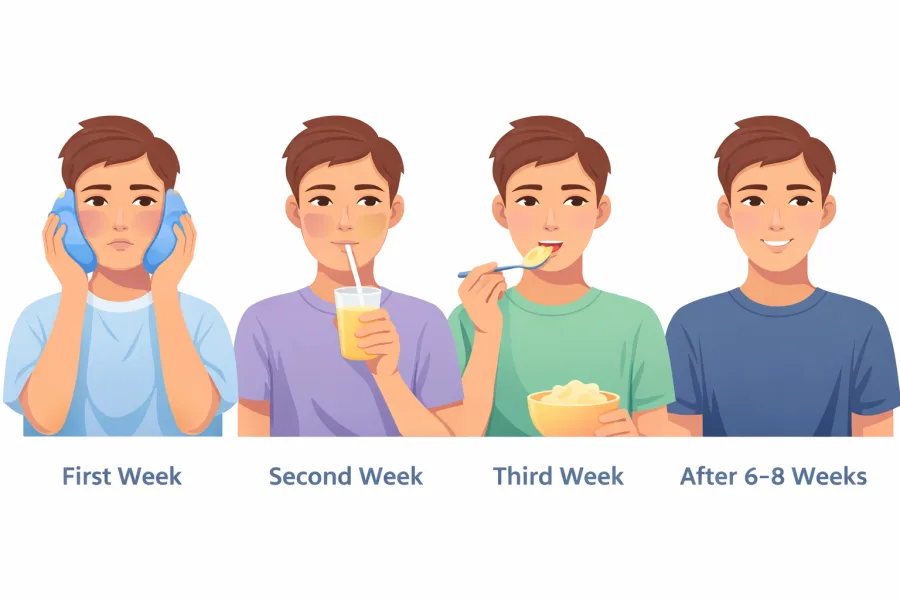
Bone consolidation requires time, yet functional recovery happens in distinct, encouraging stages. Below is an overview of what to expect from the initial week through complete skeletal maturation.
| Recovery Stage | Dietary Protocol | Physical Activity | Swelling & Sensation Status |
|---|---|---|---|
| Week 1 (Days 1–7) | Full liquids only (smoothies, pureed soups, protein shakes via cup or squeeze bottle; zero straws). | Strict rest; brief light walks around the home to encourage circulation and prevent blood clots. | Peak swelling begins to soften by day 5; lower lip and chin numbness (paresthesia) is expected. |
| Weeks 2–4 | Non-chew soft diet (mashed potatoes, scrambled eggs, Greek yogurt, flaky fish, soft avocado). | Return to desk jobs or classes (weeks 2 to 3); light treadmill walking; avoid lifting over 15 lbs. | Roughly 60% to 70% of facial edema resolves; bruising shifts from purple to yellow-green; speech clarity improves. |
| Weeks 5–8 | Soft-chew transition (tender pasta, shredded chicken, cooked vegetables) as approved by surgeon. | Moderate cardiovascular exercise; light resistance training; still no contact sports or heavy impacts. | Primary bone bridging (callus formation); residual swelling concentrated in cheeks; tingling sensations signal nerve repair. |
| Months 3–12 | Unrestricted diet; resumption of normal chewing mechanics including crusty breads and apples. | Full athletic activities and contact sports with custom mouthguards; completion of orthodontic detailing. | Complete bone remodeling; final soft tissue contouring; maximum nerve sensation restored. |
During weeks 1 and 2, your primary job is simple: stay hydrated, rest, and nourish your body. You will not have the energy to clean the house, attend social gatherings, or run errands. By week 3, most patients experience an emotional turning point as facial tightness recedes, speech becomes clearer, and real energy returns.
3. Pain Control, Caloric Nutrition, and Neurosensory Healing
Three clinical pillars govern a comfortable recovery: balanced pain relief, caloric intake, and understanding nerve regeneration.
Multimodal Pain Protocol: Surprisingly, patients rarely describe jaw surgery as excruciating. Because sensory nerves in the jaw are stretched during the procedure, the lower face remains partially numb during the initial days. Most patients experience pressure, congestion, and muscle soreness rather than acute sharp pain. We employ a multimodal analgesia approach, combining scheduled nonsteroidal anti-inflammatory drugs (such as ibuprofen) with acetaminophen around the clock. Short courses of prescription pain relievers are reserved for breakthrough discomfort during the first 48 to 72 hours, while a brief taper of oral corticosteroids helps blunt severe facial edema.
Maintaining Caloric Density: Weight loss of 5 to 10 pounds can happen if you rely solely on watery broths. Your body requires 2,000 to 2,500 calories daily to synthesize collagen, bridge bone fractures, and repair intraoral soft tissue. Blend high-calorie ingredients into your drinks: whole-milk yogurts, peanut butter, ripe bananas, protein powders, and healthy fats like MCT oil or avocado. Never use drinking straws during the first month, as negative intraoral suction can disturb healing surgical incisions or dislodge protective blood clots.
Neurosensory Regeneration: When operating near the lower jaw, the inferior alveolar nerve (which supplies feeling to the lower lip and chin) is gently mobilized. Temporary numbness, tingling, or an "asleep" feeling (neuropraxia) is standard. In the upper jaw, the infraorbital nerve can cause temporary numbness in the midface and cheeks. As nerve fibers regenerate at approximately 1 millimeter per day, you may feel pins-and-needles, sudden itching, or warm flashes. These sensory twinges are reassuring clinical signs that axons are successfully re-establishing sensory connections.
4. Warning Signs and Consultation with Dr. Johanny Caceres
While modern orthognathic surgery maintains high success and safety rates, you must remain vigilant for complications that demand immediate clinical attention. Differentiating standard post-surgical healing from an acute issue ensures timely intervention:
- Uncontrolled Bleeding: Occasional blood-tinged saliva is normal during the first 48 hours. Persistent, active dark red bleeding from your mouth or nostrils requires prompt medical contact.
- Sudden Asymmetrical Swelling or Firmness: Gradual bilateral swelling is expected. A rapid, firm, painful expansion on one side of your jaw or under the tongue may indicate a post-operative hematoma or deep fascial space infection.
- Systemic Fever: A temperature exceeding 101.5°F (38.6°C) that fails to respond to antipyretics suggests an underlying infection.
- Sudden Bite Shift: If your teeth suddenly stop meeting in the planned position or you feel hardware instability, notify your surgical team immediately for evaluation.
A successful jaw surgery journey relies on close collaboration between your orthodontist and your surgeon. At our practice, Dr. Johanny Caceres, a board-certified oral and maxillofacial surgeon, uses advanced 3D virtual surgical planning and digital dental modeling to design every movement with millimeter precision. From pre-surgical insurance pre-authorization to your one-year final milestone visit, our surgical team guides you through every phase with compassionate, personalized care.
If you are considering corrective jaw surgery, wondering if your insurance covers orthognathic care, or seeking a second opinion on your facial profile and bite alignment, schedule your comprehensive consultation today. contact Oral and Facial Surgery of Miami directly at (305) 552-1193 or reserve your appointment online through our consultation booking page.