
Sideways Wisdom Teeth? What Patients Should Expect
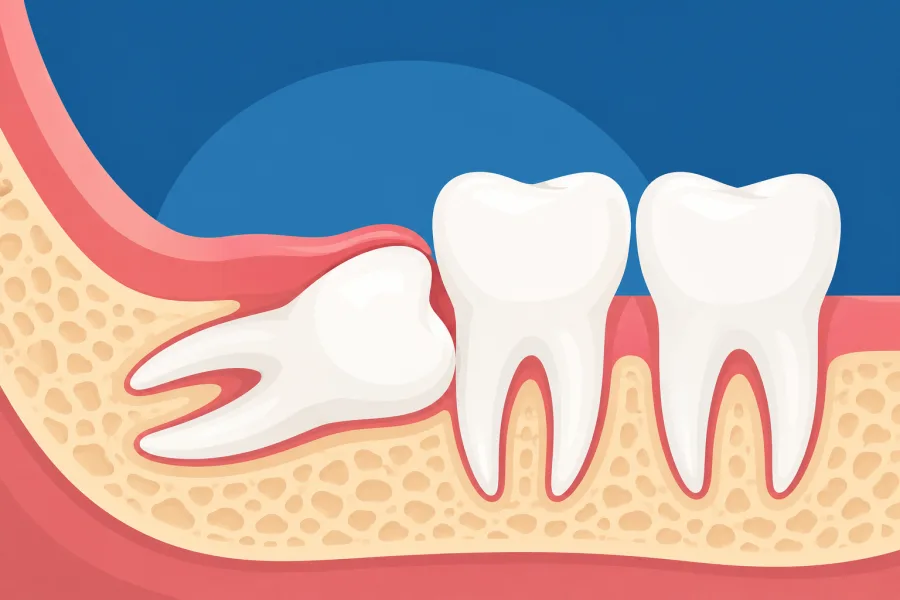
Finding out that your wisdom teeth are growing sideways is often an unsettling surprise during a routine dental exam. When a third molar tilts ninety degrees off its natural vertical axis, it cannot erupt into a functional chewing position. Instead of rising toward the opposing dental arch, a horizontally impacted wisdom tooth aims its crown directly into the flank of your healthy neighboring second molar.
Even if a sideways tooth is completely submerged beneath your gums and causing zero outward pain today, leaving it untreated carries significant biological risks. At Oral & Facial Surgery of Miami, board-certified oral surgeon Dr. Johanny Caceres helps patients navigate sideways impactions with clarity, utilizing advanced three-dimensional imaging and gentle microsurgical techniques to protect your bite, jawbone, and adjacent teeth.
1. The Biomechanics of Sideways Impaction: Why Third Molars Lie Flat
Wisdom teeth develop inside the dense cortical bone at the junction between the horizontal body of the lower jaw and the vertical ramus. Modern human evolution has favored shorter dental arches, frequently leaving inadequate space for the final four permanent molars. When the developmental path of a third molar is blocked by the back of the second molar or the ascending jawbone, the tooth bud rotates.
A horizontally impacted tooth lies completely parallel to the inferior border of the mandible. Because the root tips continue to elongate in one direction while the crown pushes in the opposite direction, the tooth can never upright itself or slide into a healthy alignment. Once a tooth reaches horizontal orientation, surgical evaluation by a maxillofacial specialist is essential to prevent collateral structural damage.
| Clinical Parameter | Leaving Sideways Teeth Untreated | Proactive Surgical Extraction |
|---|---|---|
| Adjacent Second Molar | High risk of irreversible root resorption, distal bone loss, and severe cavities below the gumline. | Completely protects and stabilizes the healthy second molar, preserving structural root support. |
| Bacterial Infections | Recurrent pericoronitis flare-ups, deep periodontal pockets, foul taste, and bad breath. | Permanently eliminates bacterial incubation pockets beneath the posterior gum tissue. |
| Jawbone Health | Potential formation of dentigerous cysts that silently hollow out mandibular bone. | Preserves cortical bone integrity; sockets fill completely with dense, regenerated bone. |
| Surgical Complexity | Higher difficulty later in life as bone mineralizes and tooth roots lengthen toward the nerve canal. | Faster, simpler surgery in adolescence and early adulthood due to pliable bone and shorter roots. |
2. The Silent Cascade: What Happens If You Ignore a Sideways Molar
Because horizontally impacted teeth are often covered completely by gum tissue, patients frequently ask whether they can simply leave them alone. While watchful waiting may be considered in rare medical situations, untreated horizontal impactions frequently lead to severe progressive pathology.
Second Molar Root Resorption: The crown of a sideways wisdom tooth exerts continuous mechanical pressure against the posterior root of the adjacent second molar. Under this pressure, specialized cells called odontoclasts become activated, dissolving the outer cementum and dentin of the healthy second molar. This destructive resorption can advance silently until the nerve of the second molar is exposed, often requiring the extraction of both molars.
Inaccessible Subgingival Decay: If the horizontal tooth partially breaches the gumline, it creates a narrow, un-cleanable crevice against the second molar. Microscopic food particles and bacteria become trapped in this gap. Because toothbrushes and floss cannot reach this subgingival crevice, aggressive cavities develop on the backside of the second molar below the gumline where standard dental fillings are impossible.
Dentigerous Cyst Development: The microscopic developmental follicle surrounding the unerupted crown can accumulate fluid, expanding into a benign but destructive dentigerous cyst. As the cyst expands within the mandible, it resorbs structural bone, weakening the jaw angle and increasing the risk of pathological jaw fractures.
3. The Modern Surgical Protocol: How Oral Surgeons Safely Remove Sideways Teeth
Removing a horizontally impacted tooth is a specialized maxillofacial procedure that requires surgical expertise far beyond routine general dentistry. At Oral & Facial Surgery of Miami, Dr. Johanny Caceres uses advanced 3D Cone Beam Computed Tomography (CBCT) to map the exact spatial relationship between the horizontal roots and the inferior alveolar sensory nerve canal.
Minimally Invasive Sectioning: Rather than aggressively removing surrounding jawbone to pull a sideways tooth out in one piece, Dr. Caceres utilizes microsurgical sectioning. After gently reflecting a conservative flap of gum tissue, the tooth is divided into smaller, manageable fragments under copious sterile irrigation. The crown is excised first, relieving the pressure on the second molar, followed by the individual roots. This delicate technique preserves maximum jawbone and reduces post-operative swelling.
Elective Coronectomy for Nerve Protection: In cases where 3D imaging demonstrates that the roots of a horizontal wisdom tooth are directly intertwined with or grooving the inferior alveolar nerve canal, Dr. Caceres may recommend an elective coronectomy. In this established surgical approach, the crown causing the impaction and risk to neighboring teeth is removed, while the healthy, uninfected root tips are left safely submerged in the bone, reducing sensory nerve alteration risks to virtually zero.
4. What to Expect During Recovery and Long-Term Healing
With intravenous (IV) twilight sedation administered in our surgical suite, you will be completely comfortable and asleep throughout the entire extraction, waking up with zero memory of the surgery. Modern post-operative protocols ensure that your recovery is smooth and predictable.
Because removing a horizontal impaction involves bone relief, moderate cheek swelling is normal and typically peaks on the second or third day after surgery before steadily diminishing. Applying cold compresses on a 20-minute on/off rotation during the first 48 hours, resting with your head elevated on extra pillows, and sticking to a smooth, nourishing diet (yogurt, pureed soups, and smoothies eaten strictly with a spoon) protects your healing sockets.
Early evaluation is the single best way to ensure an uncomplicated extraction and rapid healing. If you have been diagnosed with sideways wisdom teeth or are experiencing jaw pressure and gum tenderness in the back of your mouth, schedule a comprehensive consultation with Dr. Johanny Caceres. Contact Oral & Facial Surgery of Miami at (305) 552-1193 or book your consultation online today.