
Gum Flap Infection Around Wisdom Teeth: Causes & Care
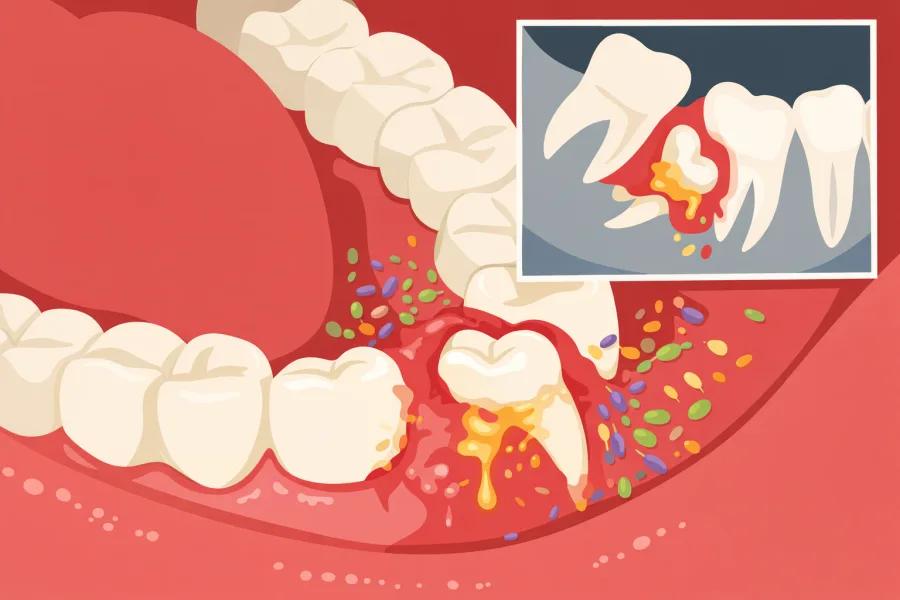
If you have ever felt a painful, swollen bump of gum tissue behind your lower back molars, accompanied by an unpleasant taste or bad breath, you have likely encountered pericoronitis. Known casually as a gum flap infection, this uncomfortable condition is one of the most frequent acute emergencies seen in oral and maxillofacial surgery practices. It occurs when a wisdom tooth attempts to emerge into a dental arch that simply does not have enough room to accommodate it.
While warm rinses or antibiotics might temporarily calm an angry gum flap, understanding why pericoronitis develops, why it relentlessly recurs, and how surgical care permanently eliminates the issue is essential for protecting your jaw and overall health.
The Anatomy of an Operculum: Why Wisdom Teeth Trap Dangerous Bacteria
To understand why gum flap infections happen, it helps to examine the mechanics of third molar eruption. When there is adequate jaw space, a tooth cuts cleanly through the gingiva until the surrounding gum tissue recedes into a healthy, tight collar around the enamel neck.
However, modern human jaws rarely provide sufficient length along the mandibular arch. As a lower wisdom tooth erupts, it often becomes partially impacted, getting stuck halfway through the tissue. This leaves a redundant, loose hood of fibrous gingiva, known clinically as an operculum, draped directly over the biting surface of the tooth.
This anatomical hood forms a deep, warm, dark pocket that is physically impossible to keep clean. Toothbrush bristles cannot reach beneath the flap, and dental floss cannot sweep the crevice. Food particles, exfoliated epithelial cells, and saliva collect beneath the tissue, creating a paradise for aggressive anaerobic oral bacteria. As colonies multiply out of reach, acute inflammation flares up, causing the tissue to swell rapidly.
Acute vs. Chronic Pericoronitis: Symptoms and Opposing Molar Trauma
Pericoronitis presents in two distinct clinical phases, each with unique challenges:
- Chronic Pericoronitis: A low-grade, persistent state of inflammation. You may notice mild, intermittent dull aching at the angle of your jaw, a persistent bad taste caused by stagnant fluids leaking from beneath the flap, bad breath that brushing cannot resolve, and occasional bleeding when chewing. Many patients live with chronic pericoronitis for months, assuming it is just slow teething.
- Acute Pericoronitis: A sudden, severe flare-up. The gum flap becomes fiery red, extremely swollen, and excruciatingly tender to the touch. Pus frequently discharges from under the tissue.
This situation is made considerably worse by mechanical bite trauma. As the lower operculum swells upward, the sharp cusps of your fully erupted upper wisdom tooth begin slamming down onto the inflamed tissue every time you chew or swallow. This continuous chewing trauma creates ulcerations, accelerates tissue breakdown, and can spread infection into the masticator spaces, causing trismus (inability to open your jaw), fever, and swollen cervical lymph nodes.
Treatment Options: Irrigation, Operculectomy, and Definitive Extraction
Treating pericoronitis depends on whether your goal is temporary crisis management or a permanent, definitive cure:
- Chairside Irrigation and Antibiotics: During an acute flare-up with severe swelling or trismus, your oral surgeon gently irrigates beneath the operculum using sterile saline and antimicrobial chlorhexidine solutions to flush out accumulated food debris and purulence. Oral antibiotics and anti-inflammatory medications may be prescribed to cool the acute infection. However, this is strictly temporary relief; as long as the flap and tooth remain, another infection is virtually guaranteed within weeks or months.
- Operculectomy (Gum Flap Excision): In rare situations where a wisdom tooth is completely vertical and has plenty of room to finish erupting, a surgeon may consider surgically trimming away the excess flap using a scalpel or laser. However, in the vast majority of patients, the gum tissue regrows or heals with thick scar tissue that forms a new bacterial pocket. For this reason, an operculectomy is rarely recommended as a standalone long-term solution.
- Definitive Wisdom Tooth Extraction: The gold standard treatment for recurring pericoronitis is surgical removal of the partially impacted third molar. By eliminating the tooth, the anatomical defect disappears entirely, the socket heals with smooth, firm gingiva, and the infection can never return.
Specialist Evaluation and Gentle Care with Dr. Johanny Caceres in Coral Gables
Allowing an infected gum flap to smolder can lead to severe complications, including deep fascial space infections, damage to the neighboring second molar roots, and dangerous bone loss behind your dental arch. At our practice, board-certified oral and maxillofacial surgeon Dr. Johanny Caceres provides precise, empathetic treatment for patients battling pericoronitis.
Utilizing in-office 3D imaging, Dr. Caceres assesses the precise angle of your wisdom tooth, its relationship to the inferior alveolar nerve, and the condition of the adjacent molar. With comfortable intravenous (IV) sedation, you can rest comfortably and wake up with the offending tooth gently removed and your chronic infection resolved for good.
End the cycle of recurrent gum infections and jaw pain. Contact our surgical team at (305) 552-1193 or book your consultation online today.